Tags
Painting a flower from life or from a photo
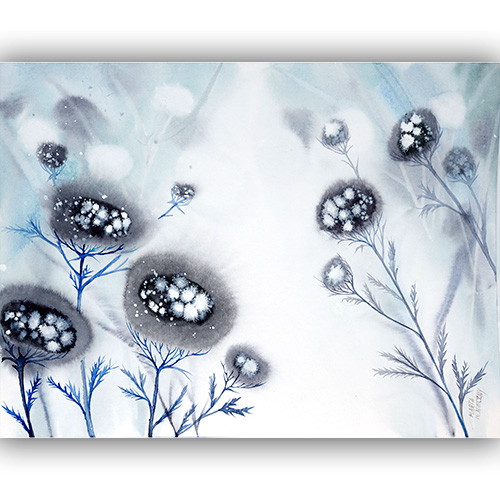
When someone looks at a painting with a plant in it, sooner or later the question comes: is this painted from life or from a photograph. The person asking usually assumes one of those answers is the better one. With plants it is not — a live model and a photograph give completely different information, and neither is enough on its own.
How long does a flower last as a model?
Less time than a painting takes. A cut poppy drops its petals within hours. A wild carrot umbel curls inwards the same day. A tulip in a warm room bends its stem and by evening shows a different profile than it did in the morning. A plant growing in soil holds out longer, but it turns towards the light and after two days it stands differently. For work that takes a week the model simply runs away — and that is the whole reason painters of plants have long reached for drawings, notes or photographs.
What will a photograph not give you?
Three things a plant depends on. Scale — in a photograph everything is equally large, while in your hand you see the seed head is a centimetre across. Depth — the camera flattens the arrangement in which some stems stand in front of others and turns it into a drawing on one plane. And colour in shadow: the camera darkens it into a dirty grey, while the eye sees reflected light in there. So even with hundreds of photographs I take the plant in my hand and look at it against the light before I start painting.
And what can you not see in front of the plant?
Whatever refuses to hold still. A photograph fixes a seed head long enough to take it apart: to count the rays of an umbel, to see how a hair leaves the stem, to check which way a tendril turns. It also lets me go back to a plant in February, when it does not exist. My nature photographs began as material for painting, and only later turned out to be works in their own right.
How do you prepare a plant for painting?
I cut in the late afternoon, never in full heat, and put the stem in water at once — a hollow stem like wild carrot drinks better if it is cut at an angle under water. I set it so the light comes from one side and mark the position of the pot in pencil, because a model moved by a few centimetres is a different picture. Plants that have gone over and dried need nothing and last for years; I have had thistles and horsetails in the studio for seasons.
Is painting from a photograph cheating?
Not as long as the photograph is your own and the painting is not a copy of it. A traced photograph shows immediately: it carries the camera's shadows, its perspective and its accidental background. A painting starts where something is chosen out of that material and something else thrown away. The same wild carrot exists here as a photograph, as a watercolour and as a form in an oil painting — and each time something different survives. How this works for a whole motif rather than a single plant is in how to paint a meadow.
Cookies
We use cookies to personalise content and ads, to provide social media features and to analyse our traffic.
We share information about how you use our site with our social media, advertising and analytics partners. They may combine it with other information you have given them or that they have collected from your use of their services.
- The site does not work without them. Always on.
- Remembering your choices, such as language.
- Anonymous visit counts, so we know what is being viewed.
- Tailoring ads outside this site.