Tags
How to paint a meadow, not a green blur
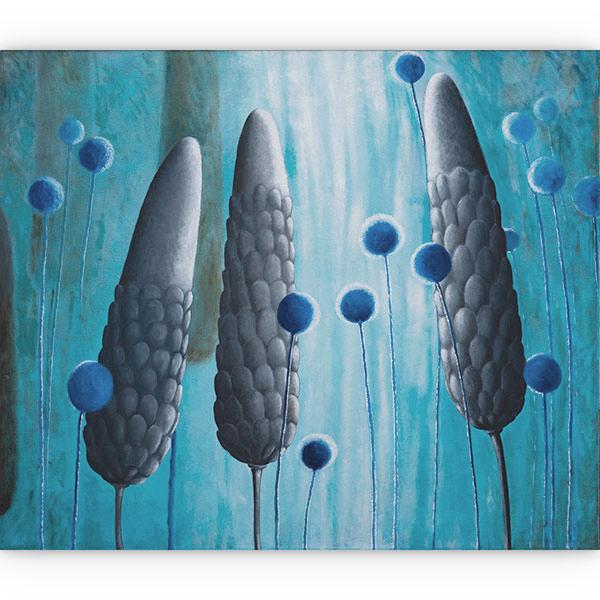
Someone paints a meadow for the first time and after an hour there is a green rectangle on the canvas. The grass is there, the flowers are there, plenty of paint has been used — and it still looks like one flat shape where nothing happens. This is the most common fault with the motif, and it almost always comes from the same thing: the meadow is painted as a colour when it should be painted as layers.
Why does a painted meadow turn into a green blur?
Because the eye sees three things at once and the hand paints one. The first is the mass: dense, dark, without drawing, sitting close to the ground. The second is the single stems and seed heads that rise out of that mass and have a clear shape. The third is the gaps — pieces of sky, light or distance visible between the plants. Paint only the mass and you get a blur. Paint only the stems and you get a drawing hanging in a void. A meadow starts to look like a meadow when those three layers are kept apart.
Do you start from the background or from the plants?
From the background, and from the darkest place. First I lay in the whole space the meadow will stand in: sky, air, the tone of the distance. Then the dark mass at the bottom, still without any shape. Only on top of that do I put the plants, working from the farthest and palest to the nearest. The order cannot be reversed — you cannot lift a pale seed head out of a dark ground that is not there yet, and you cannot push a dark ground in between finished stems without dirtying them.
How many plants have to be painted in full?
A few. Genuinely a few. A viewer recognises a meadow from a dozen or so forms that are legible, and forgives everything happening around them. Paint every single thing precisely and the picture gets loud and merges again — this time into a blur of detail. I usually choose two or three plants in the foreground, carry them through to the end, and leave the rest as a suggestion: a line, a lighter touch of the brush, a shadow.
Where does the variety come from when everything is green?
From colour temperature, not from lightness alone. Near green is warmer and more yellow, distant green is cooler and more blue — and that alone builds depth, even when both areas have a similar value. I wrote this up separately in the piece on warm and cool colours in a painting. In practice I also break the green with grey or pink: a meadow with no place free of green tires the eye.
Do you paint a meadow outdoors?
I do not. I walk the meadows with a camera and paint in the studio — a photograph holds the shape of a seed head still long enough for me to take it apart. What comes out of that walking is in my nature photographs, and what survives the brush is in the oil paintings and watercolours. Paint laid on thickly, that is impasto, helps most of all here: a seed head that physically stands off the canvas catches the light by itself and needs no drawing any more.
Cookies
We use cookies to personalise content and ads, to provide social media features and to analyse our traffic.
We share information about how you use our site with our social media, advertising and analytics partners. They may combine it with other information you have given them or that they have collected from your use of their services.
- The site does not work without them. Always on.
- Remembering your choices, such as language.
- Anonymous visit counts, so we know what is being viewed.
- Tailoring ads outside this site.