Tags
Which kind of art for which room
Why medium comes before subject
Most people start with the subject — flowers, trees, abstraction. That is natural, but it leads to disappointment, because how a work looks after a year on the wall depends first on the material and only then on the theme. Oil, watercolour, pigment print and photograph behave quite differently in a room: they react differently to light, tolerate damp differently, read differently from two metres away and cost different money.
Oil painting — when does it make sense?
Oil on canvas is the only one of these four with physical texture: brush marks, thicker and thinner passages, sometimes distinct ridges of paint. That texture lives in changing light — the painting looks different in the morning and in the evening, different under a lamp and by a window. This is its advantage and its condition: it needs space and light to show it.
So oil works where there is distance: a living room wall facing the sofa, a spacious hallway, above a chest of drawers in a room where people sit rather than merely pass through. Canvas needs no glass, so it does not reflect the window — which at a large format can be decisive.
It will not work in a kitchen or a bathroom: grease and steam settle on the surface, and an oil painting cannot be washed. My oils run from 1,000 to 5,500 PLN, most often 100 × 100 and 100 × 120 cm, the largest up to 140 × 200 cm — the oil painting gallery.
Watercolour — lightness, but behind glass
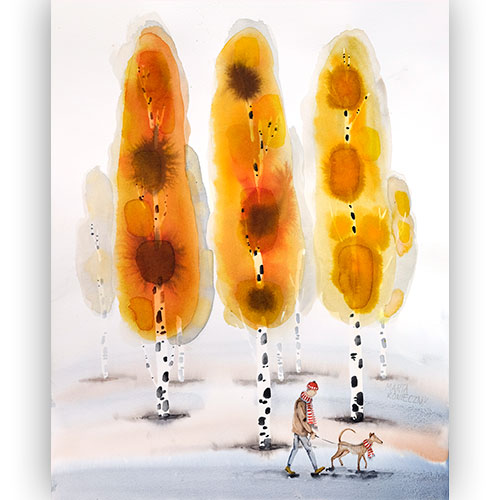
Watercolour works the opposite way to oil. It is flat and matt, and it glows not through texture but through the white of the paper showing up between layers of colour. It is meant to be seen close up — that is when the runs, the edges of washes and the settling of pigment become visible, which is the most interesting part of it.
Hence its place: a corridor, an entrance hall, the wall beside a desk, the narrow space between a door and a window — anywhere people pass close by. Watercolours also hang well in groups of several, which a large oil does not enjoy.
There is one hard condition: watercolour must be behind glass and away from direct sun. Paper and watercolour pigments fade faster than oil paint. The wall opposite a south-facing window is the worst possible spot. Prices 290–450 PLN, most often 40 × 30 and 30 × 40 cm — the watercolour gallery.
Giclée print — when a print is the wiser choice
A giclée is a pigment print on archival paper in a limited edition. It is not an original and does not pretend to be — but it is the right choice in several situations.
First, when the work will hang somewhere things can happen to it: a small child's room, a rented flat, a workplace. Second, when you are buying a gift and do not know the recipient's taste — the price of a dinner is a different decision from several thousand. Third, when you want a particular image whose original has been sold.
Prices 100–130 PLN — the print gallery. How to tell one from the other is in Original or print.
Photography — for rooms that need to stay calm
Nature photography does something in a room that painting does not: it makes no demand on your attention. It is unambiguous in subject, cool in tone and does not argue with the rest of the space. That is why it suits places where people work or wait — a study, an office, a waiting room, a bedroom.
Prints are made on archival papers in limited editions, priced 200–250 PLN. Photographs look well in sets of three or four in matching frames — the photography gallery, and the piece on the weeds of Warsaw meadows.
A short crib sheet
Living room, large wall, viewing distance over two metres — oil. Corridor, hallway, wall by a desk — watercolour behind glass. Child's room, rented flat, gift — giclée print. Study, office, bedroom — photograph. Kitchen and bathroom — only a print or a photograph behind glass, never an original on canvas or paper.
These are starting points, not rules. How to test colour before buying, and why screens mislead, is in Warm and cool colours in a painting; buying terms and the option to see a work before deciding are on How to buy.
Cookies
We use cookies to personalise content and ads, to provide social media features and to analyse our traffic.
We share information about how you use our site with our social media, advertising and analytics partners. They may combine it with other information you have given them or that they have collected from your use of their services.
- The site does not work without them. Always on.
- Remembering your choices, such as language.
- Anonymous visit counts, so we know what is being viewed.
- Tailoring ads outside this site.