Tags
Original or print — how to tell them apart
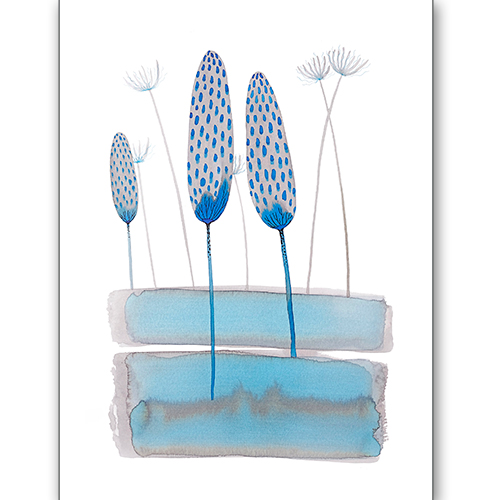
This question comes up more often than you might think, and almost nobody asks it outright — because it sounds like an accusation. It is nothing of the sort. I sell both: original paintings and watercolours, and giclée prints. So I have no reason to praise one at the other's expense.
How do you recognise an original?
Most reliably by the surface, seen at an angle with light falling from the side. An oil painting has texture: brush marks, thicker and thinner passages, sometimes distinct ridges of paint. A print is flat — even if the paper has a structure of its own, that structure is uniform across the whole sheet and does not line up with what the image shows.
With watercolour I look at the edge of a colour wash. A real watercolour has uneven pigment settling at the edges and small runs; the paper is slightly buckled where it was wet. A print has a clean edge and flat paper.
The third thing is the signature. On an original it is made with the same material as the work — paint, pencil — and sits ON the surface, so at an angle it catches the light differently from the rest. On a print, a signature copied along with the image is part of the print and looks exactly like it. A print may carry a separate, genuine signature added by hand in the margin — that is an honest arrangement, but it is still a print.
How does a good print differ from a poster?
In paper, inks and edition size. A giclée is printed with pigment inks on archival paper in a limited number of copies. A poster is made with dye inks on ordinary paper, in an unlimited run. The difference shows over time: a poster on a wall near a window starts to fade after a few seasons, while a pigment print holds its colour for decades.
When is a reproduction the better choice?
When you want a particular image whose original is no longer available or beyond your budget. When the work will hang somewhere exposed to damp or accidents — a kitchen, a small child's room, a rented flat. And when you are buying a gift without knowing the recipient's taste: a print for the price of a dinner is a different decision from an original costing thousands.
What to ask before buying
Three things, and any honest seller will answer without hesitation. Whether it is an original or a print. If a print — on what paper and in what edition. And whether a certificate comes with the work. An evasive answer to any of these is itself an answer.
Cookies
We use cookies to personalise content and ads, to provide social media features and to analyse our traffic.
We share information about how you use our site with our social media, advertising and analytics partners. They may combine it with other information you have given them or that they have collected from your use of their services.
- The site does not work without them. Always on.
- Remembering your choices, such as language.
- Anonymous visit counts, so we know what is being viewed.
- Tailoring ads outside this site.