Tags
How a plant becomes abstraction in a painting
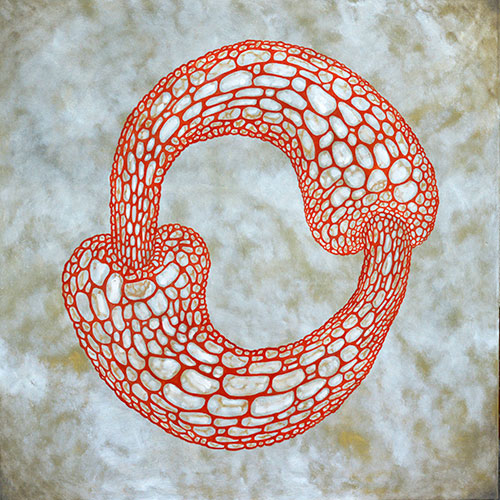
Someone stands in front of a painting and sees rhythm, branching and something spiky, but cannot say which plant it is. And usually assumes the painter observed nothing and simply invented the shapes. It tends to be the other way round: such pictures most often come out of very close looking, only the result of that looking is subtraction rather than addition.
Can you really get from a tree to abstraction?
The best documented case is Piet Mondrian's sequence of trees, held in full by Kunstmuseum Den Haag — which, as the museum itself notes, has the largest collection of his work in the world. It starts with „Tree” of 1908, a small canvas, 50 by 35.5 centimetres. Three years later comes „The Grey Tree” of 1911, almost twice as wide, of which the museum writes plainly that Mondrian brings the subject — the tree — back to its essence. Then „Flowering Apple Tree” of 1912, then „Composition Trees 1” of 1912 and „Composition Trees 2” of 1912–1913, and Tate holds „The Tree A” of about 1913. Five years, six pictures, one motif — and at the end there is no tree left, only an arrangement of lines.
What happens when you take the colour away?
In its note on „The Grey Tree” the Kunstmuseum points out something easy to miss: the lush colours of the earlier pictures have given way to shades of black, white and grey. The museum calls this a return to the basics — to drawing. It is a device anyone can use and there is nothing grand about it in itself: once a plant stops working through colour, you see whether its arrangement holds up at all. I do this with a photograph before I start painting.
And what does magnification do?
The second route is scale. The Art Institute of Chicago writes that in the 1920s Georgia O'Keeffe began the paintings of enlarged flowers for which she is most famous, and that her 1927 canvas from the white rose series is her most abstracted treatment of that subject — the energy of the blooming rose simplified to its essence. Of „Yellow Hickory Leaves with Daisy” of 1928 the museum adds that, despite carefully realistic handling of the leaves, it is the close focus that underscores their abstract qualities, and that the painter hoped viewers would „be surprised into taking time to look”. Magnification does not change the plant — it changes how long anyone looks at it.
Does photography arrive at the same place?
Earlier, and more literally. In 1928 Karl Blossfeldt published in Berlin the book „Urformen der Kunst”, with a hundred and twenty plates of plant photographs — a copy is catalogued by the Victoria and Albert Museum. He titled the pictures by the factor of magnification: the Art Institute of Chicago holds his „Symphytum Officinale (Magnified 8 Times)” of 1928. Earlier still, from 1843, Anna Atkins was issuing „British Algae” — the V&A calls her the first person to print and publish a photographically illustrated book — and her method could hardly be simpler: the plant was laid on light-sensitive paper and imprinted its own image under the sun, with no camera involved.
Where do painters get their stock of such forms?
From plates. Ernst Haeckel issued „Kunstformen der Natur” in Leipzig and Vienna between 1899 and 1904, in eleven parts, a hundred colour lithographs in all — catalogued by the Wellcome Collection. It was not a natural history album for naturalists but a pattern book: a demonstration of how the same arrangements repeat across completely different organisms. A century later my own set of photographs does exactly the same job — not to be traced from, but to have somewhere to take rhythm from.
What does that road look like in my own work?
It begins on a meadow, not in the studio. I photograph a plant, then keep one feature of it — the spikiness, the way it branches, the repetition of small spheres — and build a composition from that in which the species can no longer be named. The result is in the oil paintings, the raw material in the nature photographs, and the middle stage, where the plant is still itself, in the watercolours. What to call each of those stages is set out in the piece on what painting with plant motifs is called, and how to recognise a plant while it is still on the meadow is in the piece on weeds of Warsaw meadows.
Cookies
We use cookies to personalise content and ads, to provide social media features and to analyse our traffic.
We share information about how you use our site with our social media, advertising and analytics partners. They may combine it with other information you have given them or that they have collected from your use of their services.
- The site does not work without them. Always on.
- Remembering your choices, such as language.
- Anonymous visit counts, so we know what is being viewed.
- Tailoring ads outside this site.